
Project Description
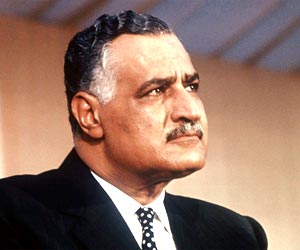
Despite being born in Bakos, Alexandria, Egypt, Gamal Abdel Nasser Hussein never truly had a home, moving all over Egypt from an early age. Nasser lived with his uncle, Khalil Hussein, in Cairo for a few years, until he moved to Alexandria to stay with his grandfather after his mother died. While in Alexandria, Nasser came into contact with the world of politics when he joined a demonstration that had taken place in the city. Nasser did not know what the people were demonstrating, but the event left a significant impression on the child.
Nasser ‘s political career began early on in life, being elected chairman of the Young Egypt Society while still a teenager. In 1935, Nasser was injured along with several other students in an anti-British demonstration where they attempted to cross Cairo’s Abbas Bridge to face-off against police. Nasser was arrested for his involvement in the demonstration and was detained along with members of the Egyptian Socialist Party. Though his wounds were minor, the nationalistic newspaper Al Gihad made Nasser’s confrontation with the police a main story. This recognition garnered Nasser significant support and further involved him in the changing political climate.
In 1936, Nasser enrolled in the Royal Military Academy in hopes of becoming a military officer. However, because he lacked recommendation from an influential military or political figure, his application was rejected. Nasser tried to enroll again, this time with the sponsorship of the Secretary-of-State, Ibrahim Kheiry Pasha, and was accepted. While studying at the academy, he met Abdel Hakim Amer and Anwar Sadat, both of whom would become important allies during his presidency. In 1938, Nasser graduated from the Royal Military Academy and joined the Egyptian Army where he was posted to the town of Mankabad and given the title of 2nd lieutenant. The following year, prior to the outbreak of the Second World War, Nasser was placed in Sudan and would establish connections with the Italian army to help them in their fight against the British. Despite this temporary assistance of the Italian forces, Egypt remained mostly neutral and Nasser saw little combat until he was stationed in Palestine in 1948 to assist in the Arab-Israeli war.
Nasser was a very successful military leader and was promoted to the post of instructor in the Royal Military Academy. However, he had frustrations with the British occupied government and, with the help of General Muhammad Naguib, began a search for military persons that could help bring about a reformation. In 1949, Nasser organized the “Free Officers,” whose main objective was to overturn the Egyptian monarchy and end Egypt’s dependence on Britain. By 1953, the “Free Officers” declared Egypt a Republic and Naguib was made President of Egypt. He would quickly be replaced by Nasser, however, being criticized for lacking passion for the cause.
Nasser’s biggest achievement came in 1954 when he had successfully nationalized the Suez Canal and put to bed years of tension and conflict with Britain. The end of the “Suez Crisis” marked a change in relationship between Egypt and the western powers, while also creating a sense of Pan Arab nationalism and pride. Nasser maintained his power and the support of his people, as well as the rest of the Arab world, until his death in 1970 caused by heart disease and long-standing complications of diabetes, a condition he shared with two of his brothers. Despite the positive opinions of his people, he remains controversial and has been criticized for being a dictator, committing numerous human rights violations. Regardless, his influence on Egypt and the Arab world remain.


Leave A Comment